The Missing Piece: LAIR vs EMDR
When designing LAIR, it became clear that the missing piece for so many people wasn’t insight, tools, or coping—it was bottom‑up processing. People who kept feeling triggered, unworthy, or “not lovable, safe, or capable” after trying other methods were stuck not because they lacked effort, but because the deeper nervous‑system code was still running on survival and trauma-rooted beliefs.
We are often asked how LAIR differs from EMDR. People have sometimes mistakenly thought LAIR is a version of EMDR. The table below helps clarify the most essential differences: approach, technique, targets, and results.
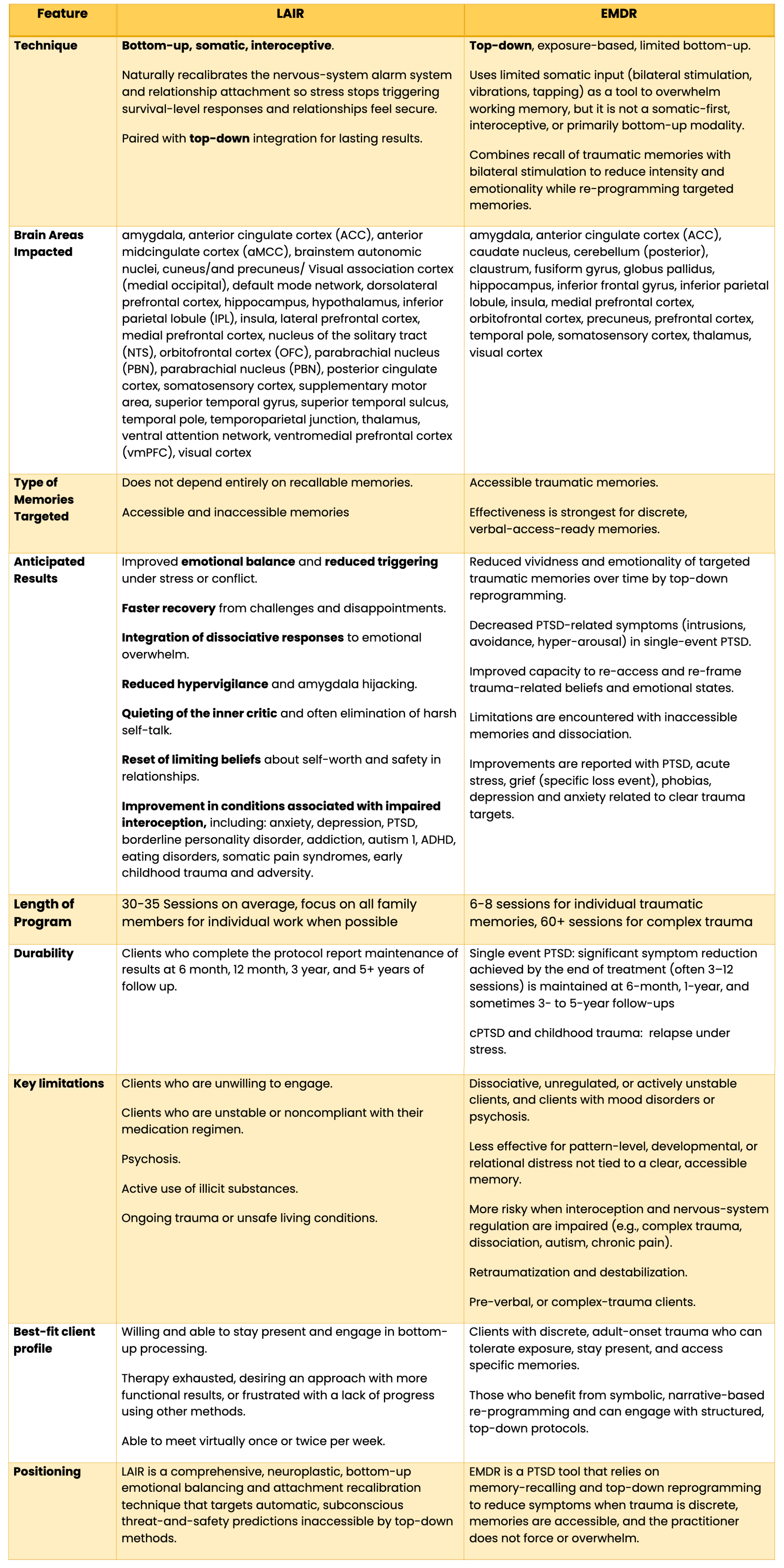
Note about interoception: The interoceptive system is the hidden network of sensory receptors throughout your body—from organs to skin—that constantly send signals to the brain about what’s happening inside, so the brain can interpret how you feel, maintain balance (homeostasis), and shape emotion, resilience, and social connection.
When interoception is impaired, people may struggle to read hunger, pain, fatigue, or emotional cues, which fuels conditions like anxiety, depression, PTSD, borderline personality disorder, addiction, autism, ADHD, eating disorders, somatic pain syndromes, and the lasting effects of early trauma and adversity. In short, interoception is the brain‑body bridge that underpins emotional awareness, emotional balance, and the ability to navigate relationships and stress with clarity and resilience.
When interoceptive deficits are not addressed, the brain continues to misread, ignore, or catastrophize internal signals, so everyday stress feels like an emergency, regulation tools don't land, relationships fracture, and the risk of self-harm, suicidality, treatment resistance, and chronic distress compound over time.
This is why bottom-up, interoceptive recalibration (like LAIR) is not a "nice-to-have add-on" but a foundational layer for clients whose systems have been stuck in survival mode despite years of insight, skills, and top-down work.

LAIR vs Other Methods
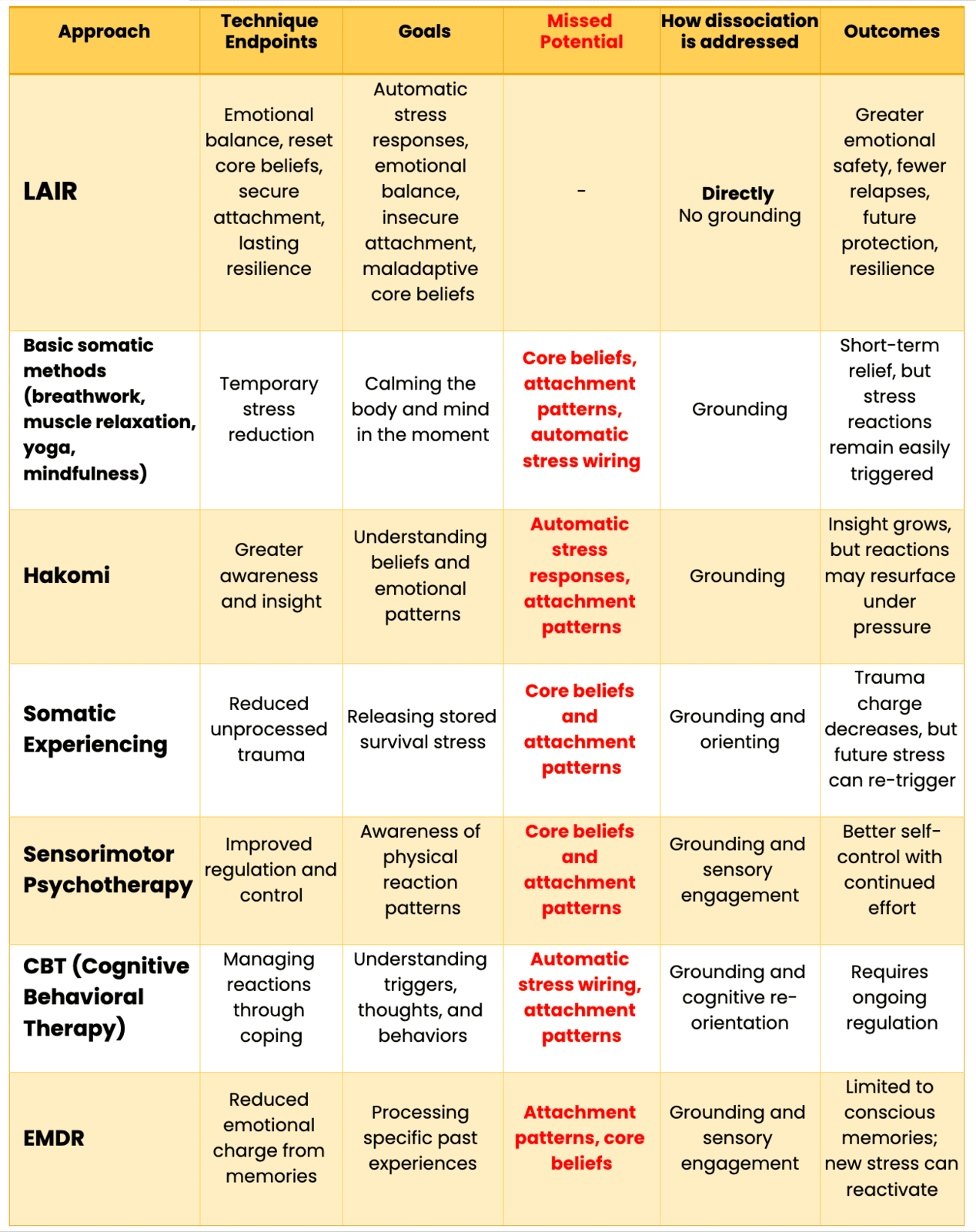
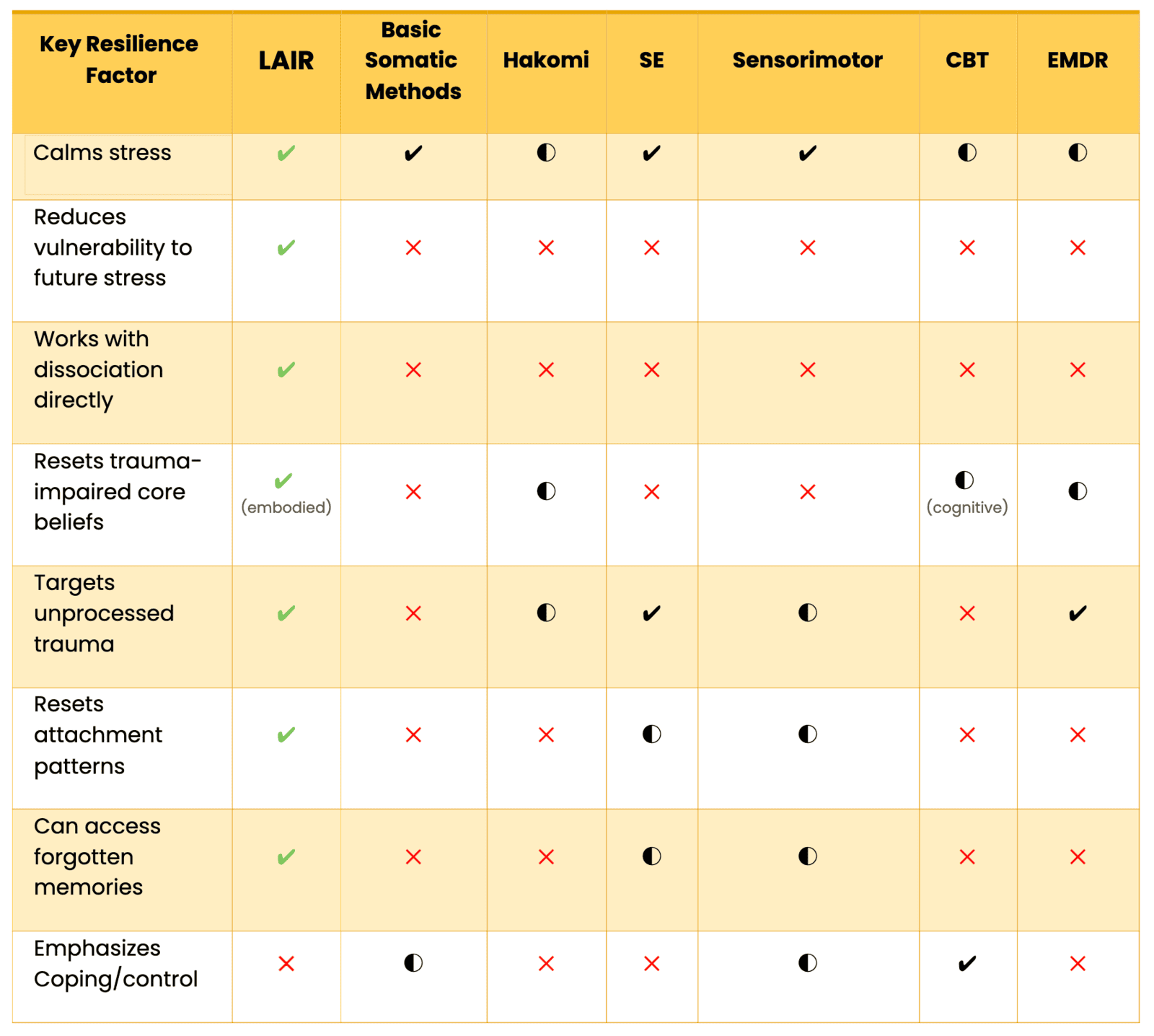
LAIR shares the bottom‑up, sensory‑based spirit of approaches like Hakomi, Sensorimotor Psychotherapy, and Somatic Experiencing, but it goes further by being a systematic, brain‑first recalibration rather than a moment‑to‑moment body‑awareness tool.
Hakomi and Sensorimotor focus on noticing sensations and slowing down reactions, which can be grounding and supportive, but they don’t systematically re‑target the deep brain circuits behind survival reflex, shame, or fragile attachment. Somatic Experiencing guides the nervous system toward completion and discharge, yet it often leaves the emotional architecture—core beliefs about self‑worth and safety in relationships—unreorganized and still reactive.
LAIR, in contrast, is designed to recalibrate the brain and body simultaneously through precise, interoceptive‑driven inputs that reshape the subconscious survival and attachment code, so change isn’t just “felt” or “regulated” in the moment, but becomes the new, automatic, emotional and relational norm.
Technique Targets & Outcomes
LAIR shifts the focus. It’s not about feeling better in the moment, chasing symptom reduction, or adding more exhausting strategies that require constant avoiding, controlling, or supressing emotions. LAIR is designed to recalibrate the brain circuits that shape emotions, memory, learning, rewards, internal balance, social connection, and fight‑or‑flight responses.
These targets are subconscious, not language‑base, automatic and wired into survival and the ability to connect and thrive. With optimized targets and by leveraging the brain’s own internal pathways, LAIR works with how the nervous system is designed, not against it. There’s no need to “manage” or “control” the system; it’s given a fresh, more empowered, and resilient foundation so that change becomes automatic, sustainable, and deeply felt.